

There is something satisfying about watching a clear, raw spirit turn into a glass of whisky that tastes of smoke, orchard fruit, and old oak. Most of us pour a dram without giving the process a second thought, yet the steps between the barley field and the bottle shape everything you taste.
If you have ever wanted to know what actually happens inside a distillery, this is a sensible place to start. We will walk through the stages one at a time: the ingredients, fermentation, distillation, maturation, and blending. Along the way I will point out where Canadian distillers fit in, because the Canadian whisky scene has earned real respect over the past decade.
Pour yourself something good. This is more interesting than it sounds.
The Origins Of Whisky
Distilling grain spirit is an old craft, and its exact origins are genuinely murky. Monks in Ireland and Scotland were distilling by the 1400s, and the practice spread through farming communities who turned surplus grain into something that kept. The earliest written record of Scotch distillation is a Scottish Exchequer roll from 1494 that granted eight bolls of malt to Friar John Cor, “wherewith to make aqua vitae.”
Those early stills were crude and the spirit was harsh. Over centuries, distillers learned to cut the run, age the spirit in wood, and build the regional styles we recognise now. Geography mattered. Peat smoke came to define much of Islay, while the lighter style of the Lowlands suited the column stills that appeared in the 1800s.
Canada wrote its own chapter. Rye grain became the backbone of Canadian whisky, and that peppery, grain-forward character is still the country’s signature today. If you want the full picture of how that style came to be, it is worth reading up on what Canadian whisky actually is.
Essential Ingredients And Their Role
Whisky starts with four things: water, grain, yeast, and time in wood. That sounds simple, but each one steers the final flavour more than you might expect.
- Water: Distilleries form around good water for a reason. The mineral content affects mashing and fermentation, and a soft Highland burn gives a different result from hard, mineral-rich water. Most distillers treat their water as a fixed part of the house character.
- Grain: Malted barley drives single malt Scotch, while Canadian distillers lean on corn and rye and American bourbon relies on a corn-heavy mash bill. The grain choice is arguably the single biggest early influence on flavour.
- Yeast: Yeast turns sugar into alcohol and, in the process, creates a whole set of flavour compounds called esters. A long fermentation tends to build more fruity esters, which is why fermentation time matters as much as the yeast strain itself.
- Wood: Ageing whisky in wooden barrels is where much of the flavour actually comes from. Ex-bourbon barrels give vanilla and coconut, while sherry casks bring dried fruit and spice. The wood can account for a large share of a whisky’s final taste.
These four building blocks are why two distilleries sitting a few miles apart can make completely different whisky. Change the water source, swap the grain, or use a different yeast, and you end up somewhere else entirely.
The Distillation Process
The first time you stand next to a copper pot still, you understand why distillers get sentimental about their equipment. Those swan-necked vessels are beautiful, but the copper also does real work. It reacts with the spirit and strips out sulphur compounds that would otherwise smell like struck matches.
Most Scotch is distilled twice. The first pass in the wash still produces a low wine at roughly 20 to 25 percent alcohol. The second pass in the spirit still is where the skill shows. The distiller makes cuts, separating the foreshots and feints (the harsh, volatile ends) from the heart of the run, which is the clean spirit that goes into casks. Irish whiskey is typically distilled three times for a lighter character, and the column stills used for grain whisky can run continuously at much higher strength.
The shape of the still matters too. A tall still with a long neck gives a lighter, more delicate spirit, while a short, squat still produces something heavier and oilier. Distilleries guard these proportions carefully, because changing the still shape would change the whisky.
Maturation And Flavour Development
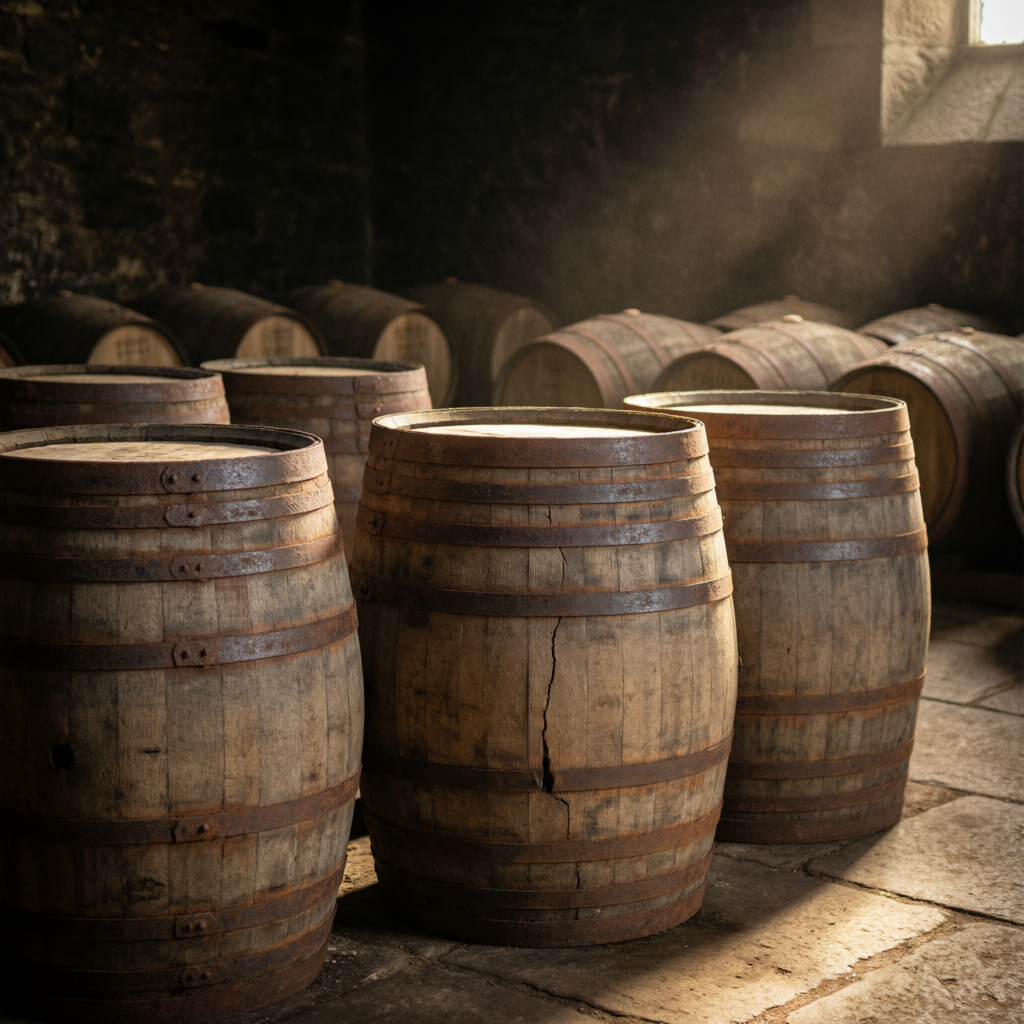
Fresh distillate is clear and fiery. Nearly everything you love about a finished whisky comes from its years in oak.
Barrel choice is the main lever. Ex-bourbon casks lend vanilla, honey, and coconut; sherry butts bring raisin, dark chocolate, and baking spice; wine barriques add brighter red fruit. Over time the spirit draws out lignin and tannins from the wood, and the harsh young distillate softens and rounds out.
Climate changes the pace. A warm warehouse ages whisky faster because the spirit expands and contracts through the wood more, while a cool Scottish or Canadian warehouse ages slowly and gently. Part of every cask evaporates each year, a loss distillers call the angel’s share, which is one reason an old whisky costs so much: there is simply less of it left.
This stage is also where money is made or lost for anyone holding casks as an asset. Sensible whisky investing starts with understanding exactly how a whisky gains value in wood, rather than chasing a label.
Blending And Bottling
Most whisky sold worldwide is blended, and blending is harder than it looks. A master blender works with dozens, sometimes hundreds, of different casks and has to hit the same flavour target every single year, even though each cask is a little different.
The goal is consistency and balance. A good blend is not just a pile of whiskies in a tank; the components have to complement one another. Grain whisky gives a soft, light base, while malts add depth and character. Once the blend is married, it is often rested in cask again so the components settle together before bottling.
Bottling strength matters too. Cask-strength whisky is bottled straight from the barrel, while most releases are diluted with water to around 40 to 43 percent ABV. A small number of bottles are non-chill-filtered, which keeps more of the flavour oils in the spirit at the cost of a little cloudiness when chilled. For tips on actually evaluating what lands in your glass, see this guide to tasting and appreciating whiskey.
Frequently Asked Questions
How has whisky production evolved over the years, and what modern techniques or equipment are now used?
The fundamentals have barely changed in centuries: grain, water, yeast, distillation, and wood. What has changed is the level of control. Distilleries now use computer-monitored fermentation, precise temperature control on stills, and detailed cask-tracking systems that let them follow hundreds of barrels at once.
None of this replaces the distiller’s judgment. The cuts during distillation and the choice of casks still come down to a human nose and palate. The industry has also kept adapting to outside pressures; this retrospective on how the whisky industry weathered the pandemic shows how quickly even traditional businesses can be forced to change.
Are there differences in production methods between countries or regions, such as Scottish, American, or Japanese whisky?
Yes, and the differences start with the rules. Bourbon, an American whiskey, must be made from a grain mix that is at least 51 percent corn and aged in new charred oak, which gives it that sweet, vanilla-heavy profile. Scotch is usually built on malted barley and often aged in used casks. Japanese whisky borrowed heavily from Scotland but tends toward precision and a cleaner, more delicate house style. Canada leans on rye and corn, often distilled in column stills. And the map keeps expanding, with emerging world whisky regions from India to Scandinavia now turning out serious bottles.
Even the spelling shifts by country, which trips up a lot of newcomers. This explainer on whisky versus whiskey clears up when to use which.
What environmental factors can influence the taste and quality of whisky during production?
Climate is the big one. Warmth speeds up ageing and pulls more flavour from the wood, while cool climates slow things down and produce a gentler, more gradual maturation. Warehouse conditions matter as much as the weather: a damp, cool stone warehouse behaves very differently from a dry, hot tin shed.
Water source and local air play a part too. Coastal warehouses can lend a faint briny note over many years, and the mineral content of the water shapes fermentation from day one.
How do whisky producers ensure consistency, especially with natural ingredients that vary year to year?
Blending is the main tool. By marrying casks of different ages and characters, a blender can hit the same flavour target even when individual casks vary. Distillers also lock down their process tightly, fixing the grain supplier, yeast strain, fermentation length, and cut points so the new-make spirit stays predictable.
Modern labs help. Distilleries run regular chemical and sensory analysis to catch drift early. The aim is that a bottle bought today tastes like the one bought five years ago, which is exactly what a loyal drinker expects.
What are some common challenges faced by whisky producers, and how are they overcome?
Consistency is the standing challenge, solved through blending and tight process control. Ageing is another: too little time leaves a spirit harsh and underdeveloped, while too long in the wrong cask can overpower it with wood or lose too much volume to evaporation.
Distillation brings its own headaches. Getting the cuts right, and holding steady temperatures through a long run, takes experience and constant attention. Supply is a longer-term worry, since whisky sold today had to be made and laid down years in advance, which means distillers are always betting on future demand.
None of these problems are new. What separates the great distilleries from the rest is that they solve them, quietly, every single year.
The View From The Bottle
Run through the whole process and one thing stands out: whisky is mostly patience. The ingredients are humble, the steps are old, and yet the gap between raw grain and a finished bottle is years of careful work that no one can rush.
Once you understand what goes into it, a dram stops being just a drink and starts being a record of decisions: the grain, the cut, the cask, the warehouse, the years. That is worth remembering the next time you pour one. And if you are ready to start collecting the bottles behind the process, this guide on how to kickstart your whisky collection is a practical next step.