


Peat is the single ingredient that can turn an ordinary malt into something you smell from across the room. Open a bottle of Laphroaig or Ardbeg and there is no mistaking it: bonfire smoke, sea air, tar, a medicinal edge that some people love and some people cannot stand. There is very little middle ground with peated whisky, and that is exactly why it has such a devoted following.
What surprises most newcomers is that peat is not added to the whisky at all. It never touches the liquid. Its influence arrives entirely through smoke, and it happens early in the process, long before the spirit sees the inside of a cask. Understanding where that smoke comes from, and why it tastes different depending on where it was cut, is one of the most rewarding rabbit holes in Scotch.
What Peat Actually Is
Peat is partly decomposed plant matter that has built up in waterlogged bogs over thousands of years. Mosses, heather, grasses and sedges fall into the wet, acidic ground and break down only slowly, compressed layer on layer into a dense, spongy material. In parts of Scotland those deposits can run several metres deep, and the lowest layers can be thousands of years old. It is sometimes called “young coal,” which is a fair description: it is essentially the first step on the long road to becoming coal.
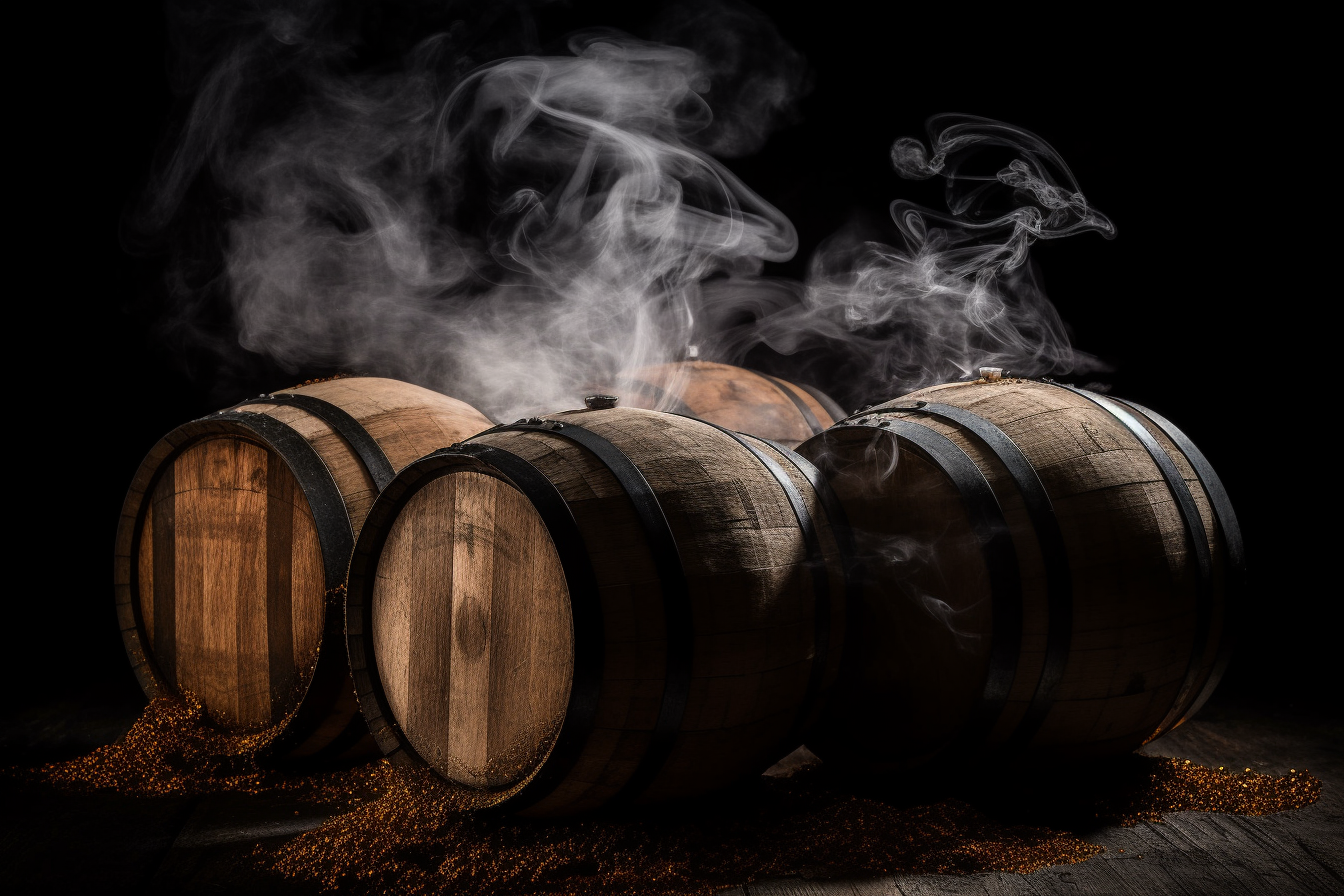
For centuries, peat was simply the fuel that was lying around. In the treeless, windy north of Scotland it was cut by hand, dried, and burned to heat homes and, inevitably, to dry barley. That local convenience became a flavour signature. Distilleries on Islay had endless peat bogs and little timber, so peat smoke ended up in their malt almost by default. Over time that accidental character became the reason people sought those whiskies out.
How the Smoke Gets Into the Malt
The flavour transfer happens during kilning, one of the final stages of malting. Barley is soaked and left to germinate, which releases the starches the distiller needs. Germination has to be stopped at the right moment, and that is done with heat. In a traditional floor malting, the green malt is spread over a perforated floor and a peat fire burns below it. The smoke rises up through the mesh and settles on the damp grain.
That timing matters. The wet, freshly germinated barley absorbs the smoke compounds far more readily than dry grain would, so the window in which the peat fire is lit, and how long it burns, shapes how much character the malt picks up. Dry the same barley over a clean, peat-free heat source and you get a lightly malty, cereal sweetness with none of the smoke. The grain is identical. Only the fuel changes.
Measuring the Smoke: What PPM Really Means
If you browse a whisky retailer’s specs you will often see a number quoted in “ppm,” parts per million. This measures the concentration of phenols, the family of smoky chemical compounds, in the malted barley itself. It does not measure what ends up in the bottle. A good share of those phenols are lost during mashing, fermentation and distillation, so the finished spirit always carries less smoke than the malt it started from.
The figure is still a useful shorthand for how aggressively a distillery peats its malt. The ranges below are approximate malt specifications as commonly reported by distilleries and maltsters, and they vary from batch to batch, but they give a sense of the spread:
| Distillery | Region | Approx. malt phenol level |
|---|---|---|
| Ardbeg | Islay | around 55 ppm |
| Laphroaig | Islay | around 40 ppm |
| Lagavulin | Islay | roughly 35 to 40 ppm |
| Bowmore | Islay | around 20 ppm |
| Springbank | Campbeltown | roughly 12 to 15 ppm |
| Highland Park | Orkney | roughly 8 to 20 ppm |
| Bunnahabhain | Islay | around 1 to 3 ppm |
Notice that Bunnahabhain sits on Islay, the island famous for smoke, yet barely peats its malt at all. That is a useful reminder that region and peat level are not the same thing. If you are curious why certain Scottish regions ended up with such distinct house styles, our piece on why Scotland still sets the standard for quality whisky goes into the geography and history behind it.
Why Peated Whisky Tastes Different From Place to Place
Two distilleries can peat their malt to the same ppm and still produce whiskies that smell nothing alike. That is because peat is not one uniform substance. Its makeup reflects what grew in the bog and what washed into it, so the smoke from an Islay bog and an Orkney bog carries different compounds.
Islay peat, cut close to the sea and influenced by seaweed and brine, tends to produce smoke that reads as medicinal, iodine-rich and maritime. That is the bandage-and-bonfire note people associate with Laphroaig. Highland peat, heavier on heather and moorland plants, leans softer and more floral, with an earthy sweetness underneath. Orkney peat, where Highland Park cuts its own, sits somewhere between, giving a rounded, aromatic smoke rather than a hard medicinal punch.
A few other factors shape what you taste in the glass:
- How long the malt sits in the smoke. More exposure generally means a bolder, more phenolic malt, though the relationship is not perfectly linear.
- The cut points in distillation. Phenols concentrate in different parts of the run, so where the stillman makes the cuts changes how much smoke survives into the spirit.
- The cask and the ageing. Smoke mellows and integrates over years in wood. A young peated malt can hit like a lit match, while the same distillery’s older bottlings turn that smoke into something rounder and more layered.
Peat in Canadian Whisky
Peat gets discussed as if it belongs to Scotland alone, but Canadian distillers have been working with smoked malt for years. The style here tends to be gentler. Canadian whisky has historically leaned on rye spice and clean, light-bodied blending, so when peat does show up it is usually a quiet accent rather than a headline.
That is starting to change. Single-estate distillers on Vancouver Island and elsewhere have released peated single malts that put local barley and local water in front of the smoke, producing something that reads as distinctly West Coast rather than an Islay imitation. If you want a sense of how far the category has come, our overview of the growing Canadian whisky scene covers the distillers worth watching, and what actually defines Canadian whisky explains the rules behind the label.
Traditional and Modern Peat Use
The big divide is between distilleries that floor-malt their own barley over peat and those that buy in malt already peated to a specification from commercial maltsters. Most Scotch distilleries today fall into the second camp. It is more consistent and far less labour, but it also means fewer houses control their smoke from the ground up. The handful that still cut and burn their own peat treat it as a point of identity, and their malt tends to carry a more idiosyncratic, less uniform character.
There has been plenty of experimentation at the edges. Some producers have tried smoking malt over other materials, and a few newer distilleries play with peat levels batch to batch to create limited releases. None of it has displaced traditional peat, though. For the distilleries built on smoke, the bog remains central, and the variation comes from how they use it rather than whether they use it at all.
Sustainability and the Future of Peat
This is the part of the conversation the industry cannot avoid. Peat bogs are carbon stores. When they are drained and cut, some of that stored carbon is released, and bogs regenerate on a timescale of centuries, not seasons. That has put real pressure on horticulture and whisky alike to think harder about extraction.
In Scotland, most distillery peat is sourced under licence, and the quantities involved are small relative to horticultural use. Still, several distilleries and industry bodies have been funding bog restoration and more careful management of existing sites. The honest position is that peated whisky can be produced responsibly, but it depends on extraction being measured and on damaged bogs being actively restored. It is a genuine concern for anyone who loves these whiskies and wants them around for the next few generations.
Collecting and Investing in Peated Whisky
Peated bottles have a habit of holding value well. The big Islay names release limited editions that sell out fast, and older closed-distillery expressions have appreciated steadily on the secondary market. Smoke also ages unusually well, so vintage peated malts from the 1970s and 1980s have become sought-after auction lots.
If that side of it interests you, our guide to how collectible bottles hold and grow value lays out the fundamentals, and building your first whisky collection is a sensible place to start before you spend serious money.
Peated Whiskies Worth Trying First
If you are approaching peat for the first time, do not start at the deep end with a full-strength cask strength Ardbeg. Ease in:
- Highland Park 12-Year-Old (Orkney): a gentle, honeyed smoke with floral notes. Often the bottle that converts people who think they dislike peat.
- Bowmore 12-Year-Old (Islay): a middle-ground Islay, smoky but balanced with lemon and a touch of sweetness.
- Laphroaig 10-Year-Old (Islay): the classic medicinal, bandage-and-brine profile. A benchmark, and the point at which you find out where you stand.
- Ardbeg 10-Year-Old (Islay): bigger, richer and more intense, with tar, anise and dark chocolate under the smoke.
Tasting them side by side, from the lightest to the heaviest, is the fastest way to understand how much range there is under the single word “peated.”
Frequently Asked Questions
Does older peat make better whisky?
Not in any simple sense. The peat burned in a kiln is typically thousands of years old already, since that is how long bogs take to build up. What matters more is what grew in the bog and how the malt is smoked, not a vintage date on the peat itself. The age of the whisky in the cask has a far bigger effect on what you taste than the age of the fuel.
Is peated whisky safe to drink, and does it have any health effects?
Peated whisky is no more or less risky than any other spirit. The phenols that give it smoke are present in tiny amounts and are not a health concern. As with all alcohol, moderation is the whole story. There is no special health benefit to peat, and anyone suggesting otherwise is selling something. Enjoy it for the flavour, not the folklore.
Why do peated whiskies from different regions taste so different?
Because the peat itself is different. An Islay bog and a Highland moor contain different plants and minerals, so their smoke carries different compounds. Add in local water, still shape and cask choice, and two whiskies peated to the same level can end up smelling completely distinct. The fuel is only the starting point.
Are there peated whiskies outside Scotland?
Yes. Ireland, Japan and a growing number of Canadian and other world distilleries produce peated expressions. Japanese examples such as those from Yoichi can carry a clean, precise smoke, while Canadian versions usually keep the peat as a lighter accent alongside rye character. The technique travels; the terroir does not.
Can the peat flavour be replicated without peat?
You can add smoky flavour by other means, and some producers have experimented with smoking malt over different materials or using peat alternatives. But distillers who have built a reputation on smoke tend to stick with real peat, because the bog gives a specific chemical fingerprint that is hard to reproduce. The environmental question is driving more research here, but for now, genuine peated character still starts with a cut from the bog.