

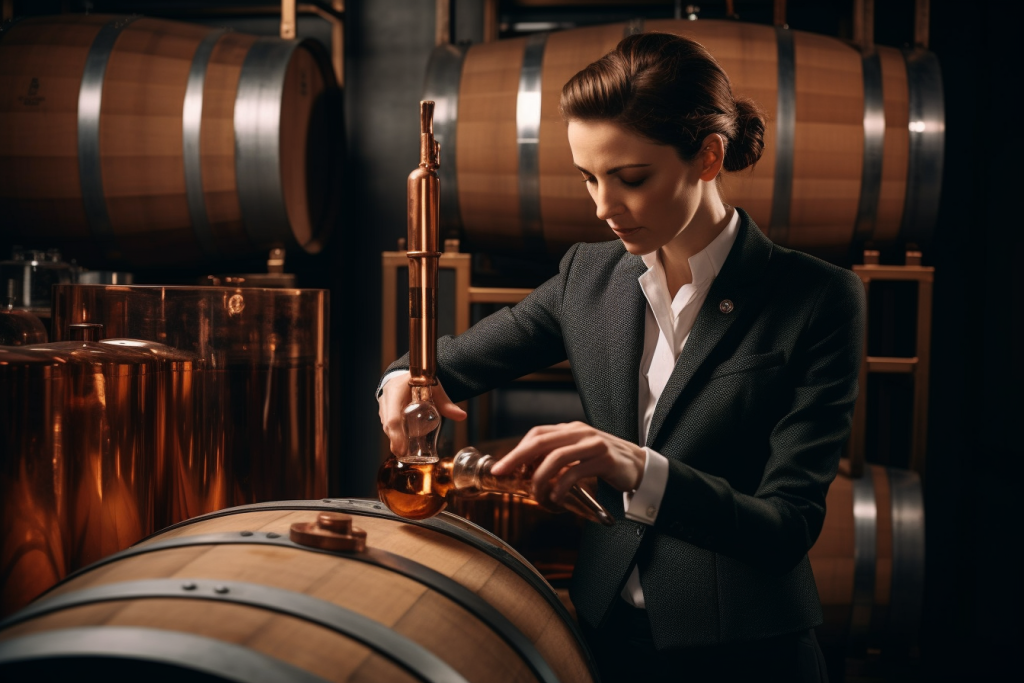
Long before there was a whisky industry, there were brewsters. The old English word brewster simply meant a woman who brewed, and for centuries women ran the kettles, the casks, and the household ledgers that kept ale flowing. That history got buried under two hundred years of industrial distilling, when the still house became almost exclusively a man’s domain. It’s only now starting to resurface.
Today, women hold the top blending and distilling posts at some of the most valuable names in the business: Bowmore, Johnnie Walker, George Dickel, Michter’s. That’s not a diversity talking point. It’s a shift in who controls flavour decisions on bottles collectors actually chase, and it changes how you should read the market.
The women running the stills right now
Rather than survey the whole field, here are the people doing the work, and what each of them means for the bottles on your shelf.
Rachel Barrie, Morrison Bowmore Distillers
Rachel Barrie started out on a Scotch whisky sensory panel in the 1990s and rose to become master blender at Morrison Bowmore, the house behind Bowmore, Laphroaig, and Auchentoshan. She is often cited as the first woman to hold a master blender title in Scotch whisky, and in the 2023 New Year Honours she was appointed an MBE for services to the industry.
Why it matters for collectors: Barrie has shaped the modern Bowmore portfolio, and the Vault Edition single malts from her era turn up at auction with regularity. Bottles from a master blender’s tenure tend to attract extra attention once that tenure ends or a milestone release lands. Older Bowmore is already a staple at houses like Bonhams and Whisky.Auction.
Marianne Eaves, Castle & Key and beyond
In 2015, Marianne Eaves became master distiller at Castle & Key Distillery in Frankfort, Kentucky, at a point when almost nobody running a Kentucky still was a woman. Coverage at the time described her as the first woman to hold a master distiller title in the state since Prohibition. She left the role in 2019 and has since been developing her own whiskey projects.
Why it matters for collectors: Eaves belongs to the wave that turned single barrel and small batch bourbon into a collector category. If the American side of the ledger is new to you, our guide to American whiskey covers the rules behind those labels.
Emma Walker, Johnnie Walker
When Diageo named Emma Walker master blender of Johnnie Walker in late 2021, she became the first woman to hold the post in the brand’s two centuries of history. She had spent years at the blender’s bench before the appointment, including time on the brand’s experimental cask programme.
Why it matters for collectors: Johnnie Walker’s prestige blends, Blue Label and the King George V edition, are among the most traded blended Scotches on the secondary market. Milestone and anniversary bottlings signed off by a new master blender tend to draw collector attention, and Walker’s era is still early.
Victoria Eady Butler, George Dickel
Victoria Eady Butler became master blender at George Dickel in 2019, the first woman to hold the role in the brand’s history, and coverage widely described her as the first Black woman to lead whiskey production at a major American distillery. She came up through Diageo’s North American supply chain before taking the blender’s seat.
Why it matters for collectors: Tennessee whiskey sits in a value corner of the American market, and Dickel’s single barrel and limited releases have a loyal following on the secondary market. Bottles attached to a first-in-history story tend to pick up collector interest once that story reaches the auction floor.
Pam Heilmann and Andrea Wilson, Michter’s
Pam Heilmann has been with Michter’s for decades and is regularly cited as one of the first women to run a major Kentucky distillery since Prohibition. Andrea Wilson, the company’s master of maturation, sets the barrel policy behind the Michter’s release calendar.
Why it matters for collectors: Michter’s annual limited releases, the single barrel, the toasted barrel finish, and the 25 year old whiskies are some of the most closely watched allocation drops in American whiskey. The maturation decisions Wilson makes shape what hits the market each year, and how long it stays allocated.
Nancy Fraley, the distillery behind the distilleries
Nancy Fraley operates on the other side of the curtain. Through her consulting practice and her own distillery work, she has advised dozens of American craft distilleries on production, ageing, and getting to market. Chances are good that a bottle from a smaller label that impressed you in the last ten years had her fingerprints somewhere in the process.
Why it matters for collectors: When you buy a craft release or a single barrel pick from an independent bottler, you are buying the judgement of consultants like Fraley as much as the brand on the label. Knowing who does the production work is a real edge when a bottle is still young and underpriced.
Jan Westcott, Spirits Canada
On the Canadian side of the border, Jan Westcott leads Spirits Canada, the national association for the country’s spirits producers. Her work is policy and access rather than the blender’s bench: trade barriers, interprovincial shipping rules, and getting Canadian products onto more shelves.
Why it matters for collectors: Canadian whisky has spent years as the undervalued corner of the market, and policy work that opens up domestic sales and export markets feeds straight into long-run demand. For the current state of play, our overview of the Canadian whisky scene is a good place to start, and our primer on what counts as Canadian whisky explains the rules behind labels like rye.
Why this matters if you collect or invest
Three threads tie the profiles above to a Canadian portfolio.
First, the customer base is getting wider. Whisky used to be marketed at one narrow demographic, and the people now running the blender’s bench are making and promoting whisky for a much larger audience. More buyers at the retail level is what eventually supports prices at the auction level.
Second, bottles tied to named master blenders already trade as a category of their own. Bowmore’s Vault Editions, Johnnie Walker’s prestige releases, and Michter’s annual limited drops all show the pattern: when the person signing the blend is a story in herself, the bottle carries extra gravity with collectors.
Third, the tax treatment is the same no matter who made the whisky. The CRA treats bottles held as investments like other collectibles, so profit on resale can be taxable, and record keeping matters from the day you buy. Factor that into your returns math before you chase an allocation. Our piece on whisky investing fundamentals walks through the model, and our notes on investing in rare whisky and casks cover the higher-risk side. Before you bid on anything, read our breakdown of how whisky auctions actually work.
Challenges that haven’t gone away
Celebrating individual careers is easier than fixing the industry underneath them. Women entering distilling still run into a smaller pipeline of mentors, less access to the capital it takes to open a distillery, and pay and credit that have not always matched the work. None of that is fixed yet.
If you want to move things forward as a consumer, three things work:
- Buy from distilleries that put women in credited production roles, not just in front of the camera.
- Support organisations like Bourbon Women in the United States and campaigns like OurWhisky in Scotland, which push for mentorship and fair representation.
- Ask who actually made the whisky. Credits on the back label are becoming more common, and consumer pressure is a big reason why.
Frequently Asked Questions
What qualifications do you need to become a distiller?
There is no licence requirement. Many working distillers studied chemistry, biology, or fermentation science, and the industry’s recognised credentials come from bodies like the Institute of Brewing and Distilling and from distilling programmes such as Heriot-Watt University’s in Edinburgh. Plenty of distillers started on the production floor and learned by doing. The credential matters less than a trained palate and time around a still.
How do women get access to blending opportunities?
Blending seats are rarely advertised, so most people reach them sideways: through sensory panels, quality control labs, or maturation roles. Joining a body like the IBD, finding a mentor through organisations such as Bourbon Women, and showing up to industry events all open doors faster than a cold application.
Does a female brand ambassador actually change anything for a brand?
Yes, for commercial reasons rather than optics. A credible ambassador widens who feels welcome in the category, and that grows the customer base. For a small craft distillery without a big ad budget, the person pouring samples at the tasting counter is often the entire marketing department.
How have women influenced the whisky industry since the beginning?
Brewing, whisky’s parent craft, was women’s work across much of medieval and early modern Europe, before industrial distilling moved production out of the household and into male-run distilleries. In the modern era, women kept footholds in lab work, sensory panels, and family operations, and from the 1990s onward they began taking the credited production roles again.
What specific challenges have women in whisky faced?
Access and recognition, mainly. Fewer mentors in senior production roles, less access to the capital needed to found a distillery, and a long history of work being credited to the man standing next to them. The pay gap in the wider drinks industry is documented, and distilling has not been immune.
Where this goes from here
Rachel Barrie picking up an MBE was a visible marker, but the more interesting signal is the pipeline underneath it: more women entering sensory science, more taking credited production roles, and more founding distilleries of their own. Watch the release notes on bottles from Bowmore, Michter’s, and Johnnie Walker over the next few years. The signatures are changing, and so is the market they feed.