

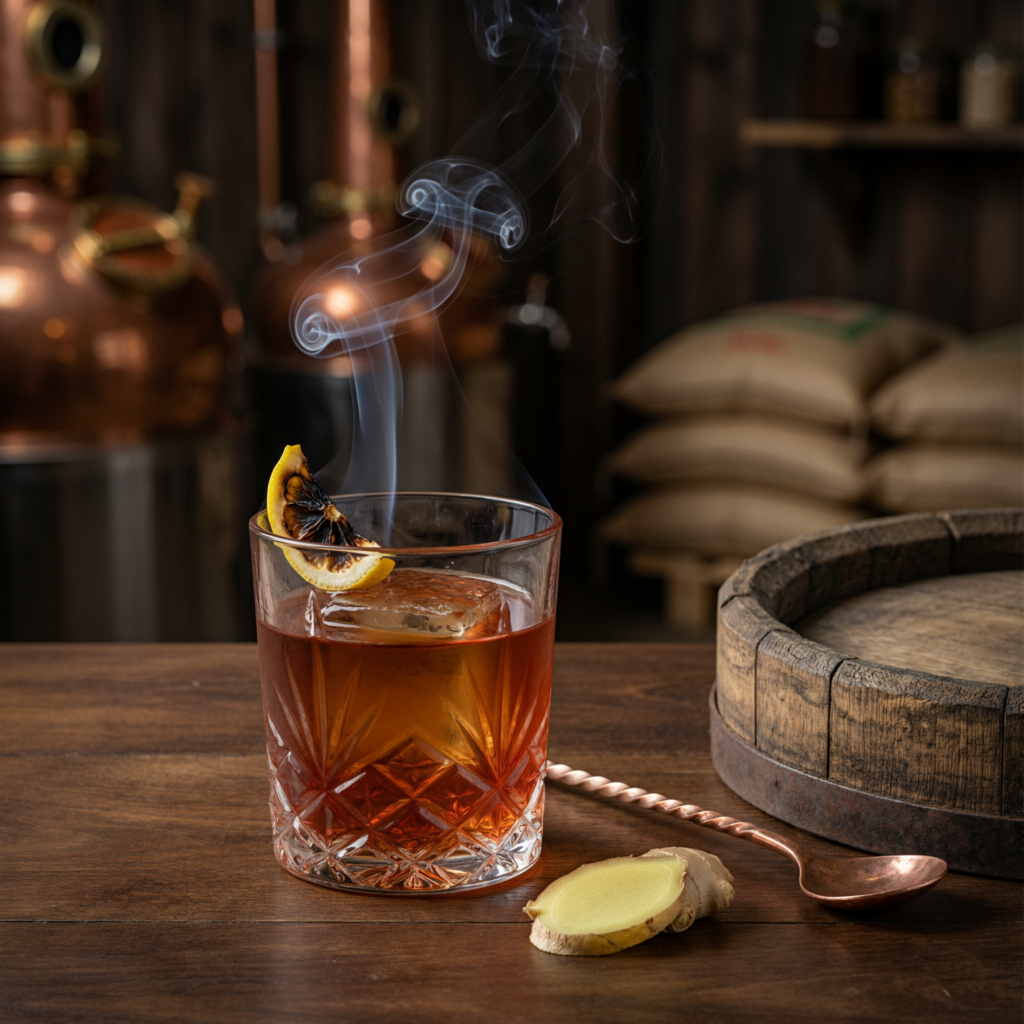
Few modern cocktails have earned their place behind the bar as quickly as the Penicillin. Built on blended Scotch, fresh lemon, and honey-ginger syrup, then crowned with a float of smoky Islay single malt, it hits sweet, sour, and smoky in a single sip. I first had one at a small bar in Toronto’s west end around 2015, and it remains my go-to order when I want something that tastes like it took more effort than it actually did.
Origins of the Penicillin Cocktail
Sam Ross created the Penicillin in the mid-2000s at Milk & Honey, the New York bar that helped launch the modern craft cocktail movement. Ross took the Gold Rush, a simple whiskey sour variation built on bourbon, honey, and lemon, and reworked it around blended Scotch. He added fresh ginger to the honey syrup and finished the drink with a float of peaty Islay malt.
The name is a playful reference to the drink’s supposed curative powers. A hot toddy’s cousin with a smoky edge, the Penicillin spread from New York to bars in London, Melbourne, and Toronto within a few years. It now sits alongside the Gold Rush and the Paper Plane as one of the defining cocktails of the 2000s craft revival.
Key Ingredients Breakdown
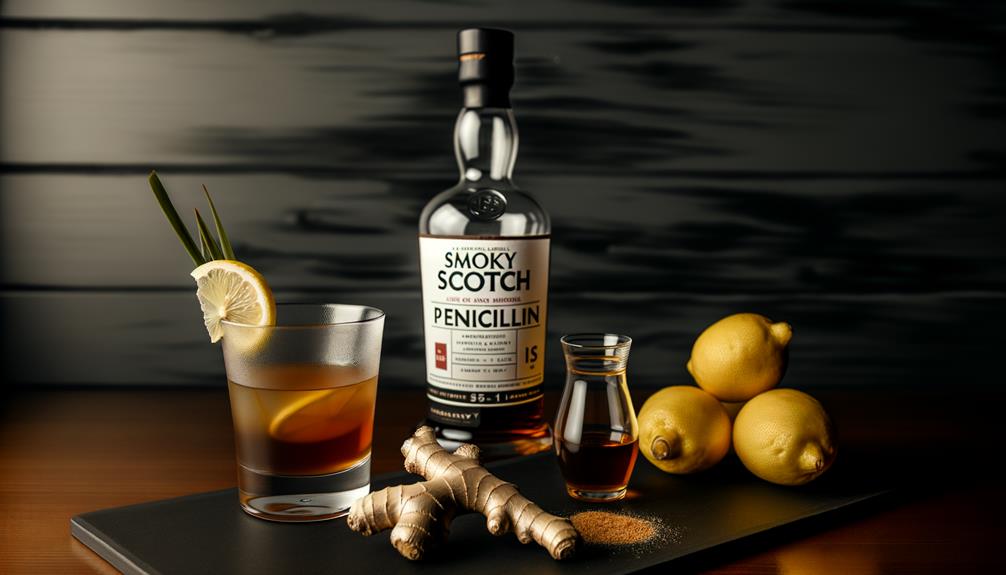
The Penicillin works because each ingredient earns its place. Here is what goes into the glass.
Blended Scotch (2 oz / 60 ml). This is the backbone. Ross has long recommended Famous Grouse, and it remains a solid pick: affordable, widely available in Canada, and balanced enough not to fight the other ingredients. Dewar’s White Label and Great King Street Artist’s Blend also work well. Avoid anything too sherried or heavily peated for the base; save those for sipping.
Fresh lemon juice (3/4 oz / 22 ml). Bottled juice will ruin this drink. Squeeze it fresh. The acidity needs to cut through the honey and the smoke.
Honey-ginger syrup (3/4 oz / 22 ml). Made by simmering equal parts honey and water with a generous amount of sliced fresh ginger, then straining. The ginger brings a warm, spicy kick that distinguishes this from a standard whiskey sour. Make a batch ahead of time; it keeps in the fridge for about two weeks.
Islay single malt float (1/4 oz / 7 ml). A small pour of Laphroaig 10 Year Old, Compass Box Peat Monster, or Ardbeg 10 layered on top after shaking. This is what makes the Penicillin a Penicillin rather than just another sour. If you are curious about why smoky Scotch works so well in cocktails, our piece on smoking a glass for an Old Fashioned covers the same territory.
Shaken with ice and strained into a chilled rocks glass, the finished drink lands at a moderate strength, roughly in line with a standard whiskey sour. Strong enough to feel substantial, balanced enough to sip slowly.
Step-by-Step Recipe Guide
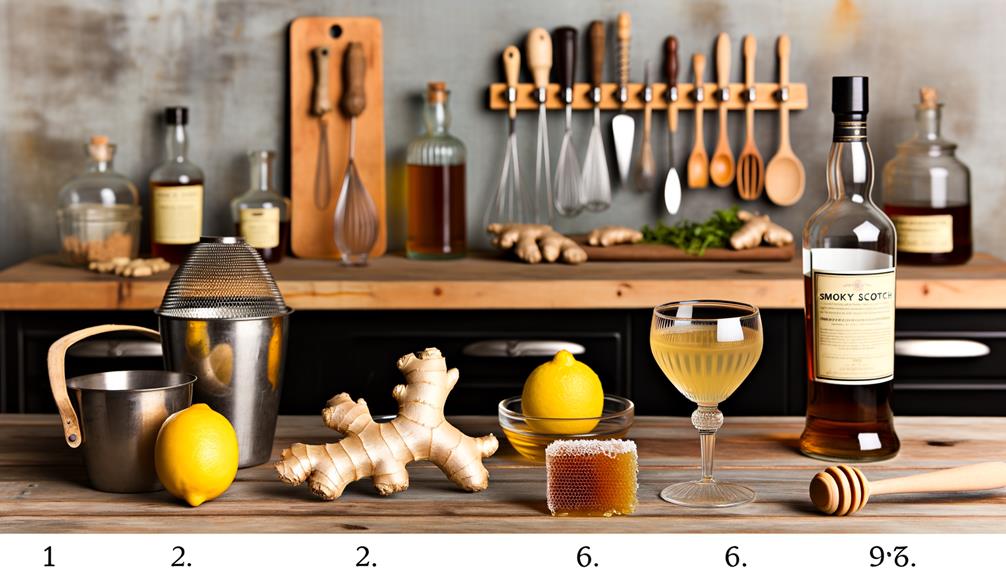
Here is the full process, from syrup to garnish.
1. Make the honey-ginger syrup. Combine 1 cup (250 ml) honey and 1 cup water in a saucepan. Add about 1/4 cup of thinly sliced fresh ginger. Bring to a gentle simmer, stir until the honey dissolves, then remove from heat and let steep for 20 minutes. Strain through a fine mesh sieve and cool completely before using.
2. Combine and shake. Add 2 oz blended Scotch, 3/4 oz fresh lemon juice, and 3/4 oz honey-ginger syrup to a cocktail shaker. Fill with ice and shake hard for about 12 seconds. You want the drink well chilled and slightly diluted.
3. Strain and float. Double-strain into a chilled rocks glass over fresh ice. Gently layer 1/4 oz of Islay single malt over the back of a bar spoon so it sits on top.
4. Garnish. A piece of candied ginger is the classic finish. Some bartenders also express a lemon twist over the surface for an extra lift of citrus oil.
| Ingredients | Steps |
|---|---|
| Honey-Ginger Syrup | Simmer equal parts honey and water with sliced ginger, steep, strain, and cool |
| 2 oz Blended Scotch, 3/4 oz Lemon Juice, 3/4 oz Honey-Ginger Syrup | Combine in a shaker with ice and shake for 12 seconds |
| 1/4 oz Islay Single Malt | Float on top after straining |
| Candied Ginger | Garnish |
Choosing the Right Scotch
The Scotch you choose shapes the whole drink, so it is worth thinking about before you pour.
For the base (the 2 oz): You want something smooth, affordable, and not too assertive. Famous Grouse, Dewar’s White Label, and Great King Street Artist’s Blend are all reliable. If you want to try a Canadian twist, a smooth Canadian rye like J.P. Wiser’s Deluxe can stand in for the blended Scotch and give the drink a spicier backbone. It changes the character of the cocktail, but in a good way.
For the float (the 1/4 oz): This is where the smoke lives. Laphroaig 10 Year Old is the classic choice, and a bottle lasts a long time when you are only pouring a quarter ounce at a time. Compass Box Peat Monster and Ardbeg 10 Year Old are also strong picks. If you are new to peaty Scotch, start with Peat Monster; it is smoky but rounder and less medicinal than Laphroaig.
Buy small bottles or samples first if you are unsure. Many provincial liquor stores (LCBO in Ontario, SAQ in Quebec, BCLDB in British Columbia) carry 200 ml bottles of Islay malts, which are perfect for testing before you commit to a full 750 ml.
Exploring Similar Whisky Cocktails
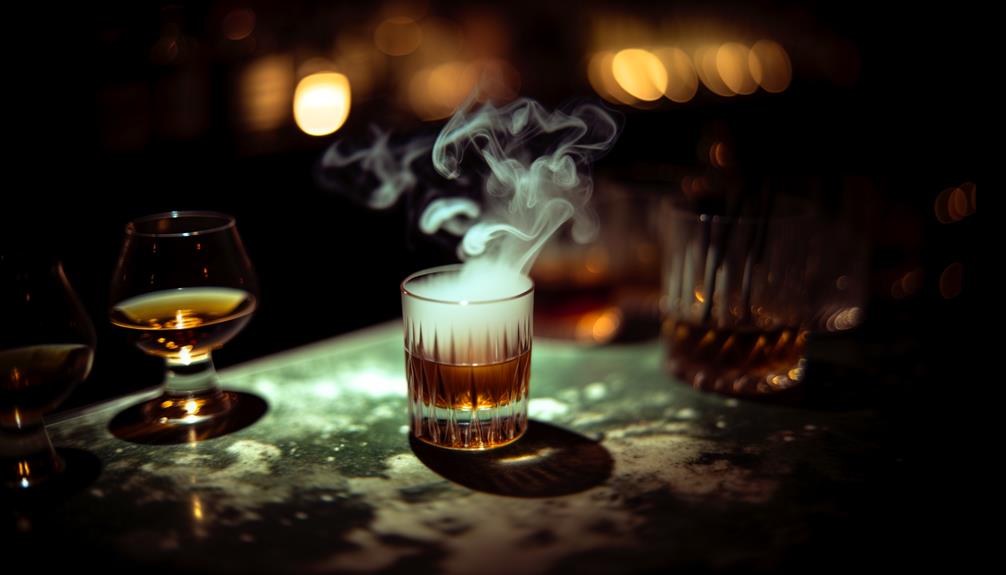
The Penicillin belongs to a family of whisky sours and whisky-forward cocktails. If you enjoy it, these are worth exploring.
Whiskey Sour. The Penicillin’s closest relative. Bourbon or rye, lemon, sugar, and optionally egg white. Skip the Islay float and you are basically here. Our guide to home-made whisky cocktails includes a solid sour recipe.
Gold Rush. The Penicillin’s direct ancestor. Bourbon, honey syrup, lemon. Simpler, sweeter, and no smoke. A good starting point if you want to understand where the Penicillin came from.
Blood and Sand. A Scotch-based classic built with equal parts Scotch, cherry Heering, sweet vermouth, and orange juice. It is fruitier and more layered than the Penicillin, and a favourite among bartenders. We have a full Blood and Sand recipe and history on the site.
Boulevardier. Whiskey, Campari, sweet vermouth. Bitter, boozy, and stirred rather than shaken. A good next step if you want to move beyond sours.
Fall-Spiced Old Fashioned. Whiskey, maple or demerara syrup, aromatic bitters, and warm spices like cinnamon and clove. Seasonal, rich, and a natural companion to the Penicillin if you enjoy whisky with autumn spice.
If you are still sorting out whether the bottle in your hand says “whisky” or “whiskey,” our explainer on the spelling difference clears that up quickly. And if you are building a home bar from scratch, our guide to kickstarting your whisky collection covers which bottles to buy first.