

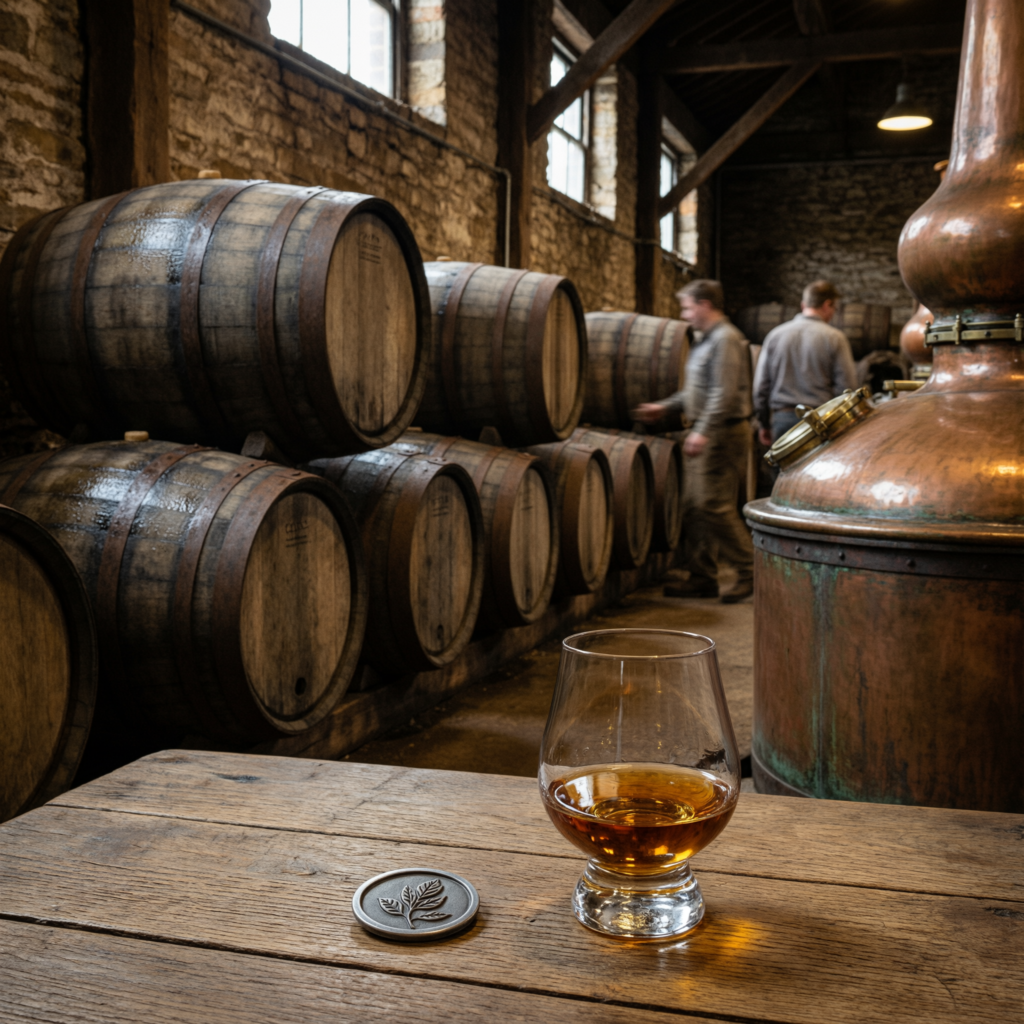
Sustainable whisky used to be a niche pitch, something a distillery mentioned in a footnote to look current. That era is over. Every major spirits group now publishes a sustainability report with carbon and water targets attached, and a new generation of distilleries is being built around renewable energy from day one. For investors, that shift matters. Sustainability is no longer a branding exercise; it is becoming a measure of which distilleries can keep costs down, hold their licences, and keep customers loyal over a ten-year holding period.
Here is where the money actually goes, which green claims hold up, and where the risks sit. If you want the operational side first, our guide to eco-friendly distilling practices explains what sustainable production looks like inside a working distillery.
What Sustainable Production Actually Means
Strip away the marketing and sustainable whisky production comes down to a short list of measurable choices: where the grain comes from, where the energy comes from, what happens to the water, and what the bottle is made of.
- Local and regenerative grain. Shorter supply chains cut transport emissions and give a distillery a story tied to real farmland. Several Canadian craft distillers already source barley within a few hours of the still.
- Renewable heat and power. Biomass boilers, anaerobic digesters, heat recovery, and renewable electricity contracts are all in commercial use. Glenmorangie in Scotland runs an on-site anaerobic digester that turns distillery waste into biogas.
- Water stewardship. Distilling takes several litres of water per litre of spirit, so the leading operators measure and publish their draw, and some are restoring the catchments they rely on.
- Packaging. Lightweight and recycled glass is the fastest-moving area. Nc’nean on the west coast of Scotland bottles its single malt in 100% recycled glass, a first for a UK spirits brand.
None of this is cheap, and that is part of the investment story. Distilleries that have already made these capital upgrades carry lower energy and waste costs for decades. The ones that have not will be retrofitting under pressure, often at worse prices.
The ESG Money Behind It
The bigger recent story is regulatory. Under the EU’s Corporate Sustainability Reporting Directive, large companies began reporting audited ESG data from the 2024 financial year onward. Those rules reach into the spirits aisle. European distributors and retailers increasingly ask suppliers for verified emissions numbers, and distilleries that cannot produce them risk losing shelf space.
The industry’s own targets back this up. The Scotch Whisky Association has set its members a net-zero goal for 2040. Diageo’s Spirit of Progress plan aims for net-zero operations by 2030. Pernod Ricard runs its “Good Times from a Good Place” roadmap with 2030 targets across grain, water, and packaging. Suntory has made similar commitments for its Japanese and global operations. These are board-level promises now, with budgets attached, and they flow down to the smaller distilleries in each group’s stable.
For investors, the practical takeaway is simple. A distillery’s ESG posture is now a proxy for management quality. Operations that can document their emissions and water use tend to be run with the same discipline everywhere else. Getting the fundamentals of whisky investing right starts with reading the operations report as carefully as the tasting notes.
Evaluating Investment Opportunities

Money enters sustainable whisky through four doors, each with a different risk profile.
- Rare bottles. Bottles from closed distilleries, discontinued lines, and single-cask releases. A producer’s environmental record is starting to show up in auction catalogue write-ups, and it will matter more as younger, eco-minded bidders set prices.
- Whole casks. Platforms such as WhiskyInvestDirect and Platinum Cask let individuals buy and hold full barrels. You are betting on maturation, provenance, and eventual exit liquidity, and the distillery’s sustainable provenance is part of that story. Our barrel investing guide covers the mechanics, including fees, storage, and how exits actually work.
- Distillery equity. Public groups like Diageo, Pernod Ricard, and Brown-Forman give you exposure to their sustainability spending as part of the whole business, which dilutes the pure-play angle along with the risk.
- Canada’s craft tier. The Canadian distillery count has multiplied over the last decade, and many of the newer builds put local grain and efficient stills at the centre of their model. If this corner interests you, start with our Canadian whisky scene overview.
One caution on returns. Headline numbers you see online for cask programs are marketing, not audits. Treat any projected internal rate of return with suspicion, and ask how previous buyers actually exited.
Risks in Sustainable Whisky Investment
The upside is real, and so are the ways this can go sideways.
- Market volatility. Rare whisky cooled from its 2021 and 2022 highs as interest rates rose, and secondary-market prices are still finding their footing. Sustainable credentials do not immunise a bottle from a market correction.
- Greenwash and verification. Not every green claim survives contact with an auditor. Carbon-neutral claims in particular rest on offsets that vary widely in quality. If a distillery’s ESG story matters to your thesis, check the certification behind it (B Corp, PAS 2060 carbon neutrality, audited Scope 1 and 2 emissions) rather than the ad copy.
- Regulatory drift. Reporting standards and eco-labelling rules are still being written. What counts as “sustainable” in 2024 may be redefined by 2027, and some claims that travel well in marketing may not travel well under new disclosure rules.
- Supply chain exposure. Grain harvests fail, water allocations tighten, and barrel stave oak gets more expensive. A distillery with deep local supplier relationships rides these shocks better than one importing everything.
- Cask-market illiquidity. Whole-cask platforms carry lighter oversight than securities markets, and consumer watchdogs have warned about boiler-room style cask schemes. If a cask offer promises fixed returns, treat it as a red flag.
These risks are manageable with ordinary due diligence: read the filings, visit if you can, and never size a position you cannot hold for years.
Case Studies: Where Sustainability Paid Off

A few operators show what happens when sustainability is built into the business rather than bolted on.
Bruichladdich, Islay. It became the first Scotch whisky distillery to earn B Corp certification, in 2020, while commanding some of the strongest secondary-market premiums on Islay outside its giant neighbours. Provenance and principles sold together.
Nc’nean, Argyll. Scotland’s first net-zero whisky distillery, powered by renewable energy, with 100% recycled glass bottles. The story has made it one of the most talked-about small malts in the international trade.
Ardnamurchan, Highland. Certified carbon-neutral, running largely on local hydro and solar power, with its own estate-grown barley program. A small operation whose environmental pitch is part of the product.
Glenmorangie, Highland. Its on-site anaerobic digestion plant has been turning distillery waste into biogas since 2015, a capital project that now pays for itself in energy savings while feeding straight into the brand’s story.
Platinum Cask, United States. On the cask side, independent bottling and cask-investment programs like Fah Mai Holdings’ Platinum Cask have put whole-barrel ownership in front of retail investors. The lesson here is less about their specific numbers, which deserve scrutiny, and more about the appetite for transparent, story-rich cask programs.
The pattern across all of these is the same. The sustainability spend either cut costs, built brand, or did both, and the value showed up in the bottle’s price or the business’s margins.
Where Sustainable Whisky Is Headed
Over the last couple of years, a few things have settled into place.
- Net-zero has become table stakes for new builds. A distillery opening in 2025 or 2026 without a renewable heat plan is the exception now, not the rule.
- Regenerative grain programs are spreading. More distilleries are contracting directly with farms on soil-health programs, because the grain story is the cheapest credibility they can buy.
- Disclosure is getting audited. With CSRD-style reporting spreading, “sustainable” will increasingly mean something a verifier has signed off on, not something a marketer has written.
- Demand keeps tilting toward premium. Drinkers in established and newer markets alike keep trading up, and producers with a credible origin story capture more of that premium than commodity players.
None of this makes a green distillery an automatic good investment. It means sustainability has moved from the brochure to the balance sheet, and that is exactly where an investor can actually evaluate it. If you are weighing where this fits in a broader portfolio, our piece on whisky investment strategy is a good next step.
Frequently Asked Questions
How Much Can You Make Investing in Whisky?
Honestly: anywhere from a loss to a life-changing multiple, with most results somewhere in between. Knight Frank’s Wealth Report tracks rare whisky alongside art, wine, and watches, and the category has spent long stretches near the top of that index. The best-case examples, think rare Macallan or bottles from closed distilleries, have outpaced inflation by a wide margin over ten-year holds. The average bottle in your cabinet, though, is not an asset. Buy what you love, and let any upside be a bonus.
Is a Whisky Collection a Good Investment?
It can be, under the right conditions: bottles from real producers with proven secondary markets, proper storage and insurance, and a time horizon measured in decades. The costs that eat returns are the boring ones, namely storage, insurance, auction fees, and taxes on collectibles. If you are building a collection with profit in mind, read up on investing in rare whiskey and casks before you spend seriously.
What Is the Future of the Whisky Industry?
Growth, but unevenly spread. India is already the world’s largest whisky market by volume, and its premium tier is growing fast. Japan keeps setting records at auction. North America is consolidating around bigger craft players. And underneath all of it, the industry’s green transition is moving from press releases to audited targets. The distilleries that treat energy, water, and grain as costs to manage, not marketing to write, are the ones likely to still be thriving in 2040.
Are Whisky Casks a Good Investment?
They can work as part of a spread portfolio, with the right platform and realistic expectations. The short version is that you are buying an ageing asset that costs money to store, in a market with lighter oversight than equities, and your exit depends on the platform’s buyer network. Sustainable provenance is becoming a selling point at exit, which is one more reason to favour barrels from distilleries with verifiable green credentials.