

Mark Twain once said, “Too much of anything is bad, but too much good whiskey is barely enough.” Judging by the numbers, most of the planet agrees. Global whisky demand has kept climbing through the mid-2020s, fuelled by premium spirits, a wave of craft distilleries, and trade routes that put a bottle from Islay or Hokkaido on a shelf in Calgary within days.
The growth is real, but so is the complexity. Distinct categories (Scotch whisky, Irish whiskey, bourbon, rye, Japanese whisky, Canadian whisky) each move on their own cycle, and the regions driving the next wave of consumption are not the ones that dominated the last century. For Canadian drinkers and investors, that shift creates genuine openings. The trick is knowing where to look and what the numbers actually say.
Global Whisky Market Overview
Estimates from research firms like Statista and IWSR put the global whisky market in the range of USD 55 to 65 billion in revenue through 2024 and 2025, with most forecasters projecting steady single-digit annual growth over the following five years. The exact figure depends on whether you count ready-to-drink cocktails, flavoured expressions, or only traditional aged whisky, so treat any single number with a healthy dose of scepticism.
What the data does show clearly is a shift in where growth happens. Asia-Pacific, led by India and Japan, has been the fastest-growing region by volume. IWSR has repeatedly flagged India as the largest whisky market on earth by litres sold, though most of that volume is domestic brands at lower price points. Meanwhile, Japanese whisky has gone from a niche curiosity to a serious competitor for Scotch, with export values from Japan climbing sharply through the early 2020s.
The big corporate players remain familiar names: Diageo (Johnnie Walker, Talisker, Lagavulin), Pernod Ricard (Chivas Regal, The Glenlivet), Beam Suntory (Jim Beam, Yamazaki, Hakushu), and Brown-Forman (Jack Daniel’s, Woodford Reserve). Their quarterly reports are a useful pulse check for anyone tracking the broader market.
Emerging Whisky Markets

The Asia-Pacific story deserves its own paragraph. India’s middle class is expanding, and with it comes an appetite for premium imported whisky. Diageo has called India one of its most important growth markets, and the company has invested heavily in local distribution. Japan, of course, is both a massive consumer and a producer whose bottles now command serious prices at auction.
Beyond Asia, other regions are worth watching. African markets, particularly South Africa and Nigeria, are seeing growth in spirits consumption. Latin America remains dominated by local spirits, but whisky imports have been ticking upward. For a closer look at regions that are building their own whisky identities, check out our guide to emerging world whisky regions.
The flavoured whisky segment has also expanded, driven largely by younger consumers who want something more approachable than a straight pour. Brands like Jim Beam Honey and Jack Daniel’s Tennessee Honey have been commercial hits in North America. Whether flavoured whisky represents a gateway to the broader category or a dead end is a fair debate, but the sales figures are hard to ignore.
On the other end of the spectrum, non-alcoholic whisky alternatives have carved out a small but growing niche. Brands like Spiritless Kentucky 74 and Lyre’s American Malt target consumers who want the flavour ritual without the alcohol. It’s a tiny slice of the market, but it speaks to broader shifts in how people think about drinking.
Trends Shaping the Whisky Industry
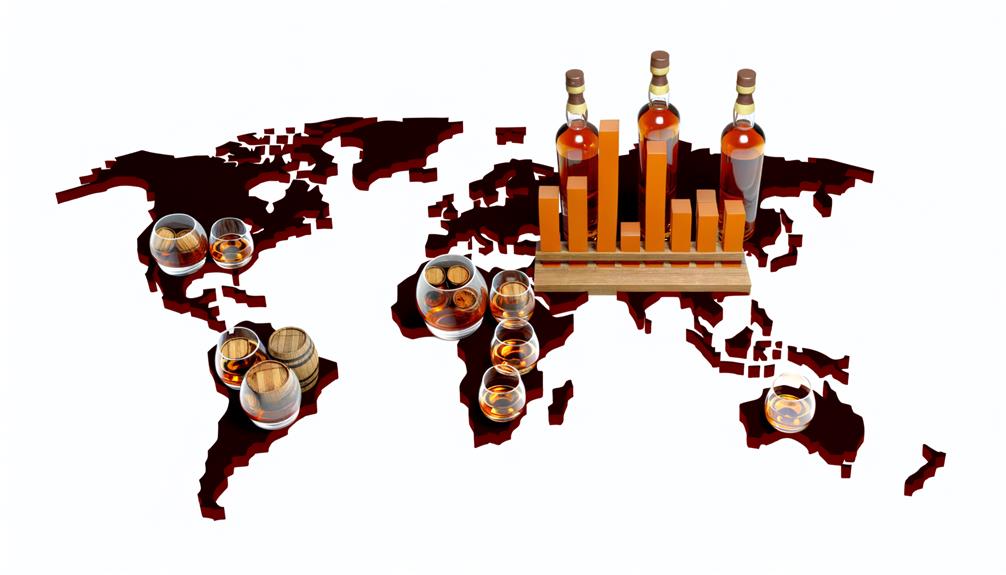
Several trends have defined the market through the mid-2020s. None of them are secrets, but understanding how they interact matters if you’re thinking about where to put your money or your attention.
- Premiumisation: Consumers are drinking less but spending more per bottle. Scotch single malts, aged Japanese expressions, and small-batch bourbons have all benefited. This trend has been consistent across most major markets since the early 2020s and shows little sign of reversing.
- Japanese whisky’s rise: Japanese whisky exports grew dramatically through the 2010s and into the 2020s. Bottles like Yamazaki 12 and Hakushu 12, once easy to find for under $100, now sell for several times that. The category has moved from novelty to blue chip.
- Flavoured and approachable expressions: Younger drinkers, particularly in North America, have driven growth in flavoured whisky and ready-to-drink formats. This has expanded the total addressable market beyond traditional whisky drinkers.
- Non-alcoholic alternatives: Still a niche, but the category has moved from joke to legitimate product line. Major retailers now stock alcohol-free whisky alongside the real thing.
- Canadian whisky’s quiet comeback: Domestically, brands like Crown Royal, J.P. Wiser’s, and Forty Creek have held steady, while newer distilleries such as Shelter Point on Vancouver Island and Dillon’s in Niagara have pushed the quality ceiling higher. If you want to understand what makes the Canadian category tick, our primer on Canadian whisky is a good starting point.
Investing in Whisky: Opportunities and Risks

Whisky as an investment asset has attracted serious attention over the past decade. Rare bottle indices tracked by firms like Knight Frank have shown whisky outperforming several traditional asset classes over certain periods, though past performance is never a guarantee of future returns. The key drivers remain scarcity, brand prestige, and ageing time.
That said, the risks are real and often underappreciated. Liquidity is poor compared to stocks or bonds; selling a rare bottle quickly usually means accepting a discount. Storage and insurance add ongoing costs. Provenance and authenticity are constant concerns, especially at the high end. And the market is not immune to broader economic slowdowns; luxury spending tends to soften in recessions.
For Canadian investors specifically, there are tax considerations worth understanding. The CRA treats collectibles (including rare whisky) differently from securities, with a $1,000 minimum cost threshold and specific capital gains rules. It’s not legal advice, but it’s worth talking to a tax professional before building a serious position.
If you’re considering this path, our detailed whisky investing guide covers the fundamentals, and our guide to investing in rare whisky and casks goes deeper on barrel-level opportunities.
Case Studies: Success in the Whisky Market
Suntory Holdings (Japan): Suntory’s acquisition of Beam Inc. in 2014 created Beam Suntory, one of the world’s largest spirits companies. The move gave Suntory global distribution for its Japanese whisky portfolio while building on Bourbon’s strength in North America. Yamazaki and Hakushu have become some of the most sought-after bottles on the secondary market.
The Edrington Group (Scotland): Edrington, the family-owned company behind The Macallan and Highland Park, has focused relentlessly on the luxury end of Scotch whisky. The Macallan’s limited-edition releases consistently fetch high prices at auction houses like Sotheby’s and Bonhams, reinforcing the brand’s prestige positioning.
Brown-Forman (United States): Jack Daniel’s remains one of the most recognised spirits brands on the planet. Brown-Forman has expanded the lineup with flavoured variants and premium expressions, capturing both the everyday drinker and the collector. Their flavoured whiskey line has been a commercial success, particularly in the U.S. and Canada.
Pernod Ricard (France/Ireland): Pernod Ricard’s ownership of Irish Distillers (Jameson, Redbreast, Powers) has positioned the company to ride the Irish whiskey revival. Jameson has become the best-selling Irish whiskey globally, and the company has invested in new distillation capacity to keep up with demand.
For anyone watching these companies, auction results are a useful barometer. Our whisky auctions guide explains how the secondary market works and what to watch for.
Frequently Asked Questions
What is the future of the whisky industry?
The fundamentals look solid through the mid-2020s. Premiumisation continues in established markets, Asia-Pacific is growing by volume, and new categories like non-alcoholic whisky are finding their audience. The biggest question marks are macroeconomic: inflation, trade policy, and consumer confidence all affect luxury spending. But whisky has shown resilience through past downturns, and the long-term trend of trading up from cheap to premium shows no sign of stopping.
What are the biggest trends in the global whisky market?
Premium and craft spirits continue to take share from value brands. Japanese whisky has moved from trend to permanent fixture. Flavoured and ready-to-drink formats are expanding the consumer base. And non-alcoholic alternatives, while still small, are no longer a novelty act. The Canadian scene is part of this story too, with new distilleries raising the quality bar year over year. Our overview of the Canadian whisky scene covers who’s doing what at home.
Is whisky a good investment in 2026?
It can be, with caveats. Rare bottles from established houses (Macallan, Yamazaki, old Bowmore) have held value well. But liquidity is limited, storage costs are real, and the market is less transparent than equities. Treat whisky as a passion asset that might appreciate, not as a retirement plan. Diversify, buy what you genuinely love, and never invest money you need in the short term.
What is driving whisky sales globally?
Three things: consumers trading up to premium bottles, growth in Asia-Pacific (especially India), and the expansion of whisky culture into new demographics through flavoured expressions and cocktail culture. Even alcohol-free whisky is pulling in curious consumers who might later cross over to the real thing. The category is broader and more accessible than it was a decade ago, and that breadth is good for long-term demand.